Will AI Ruin Trading?
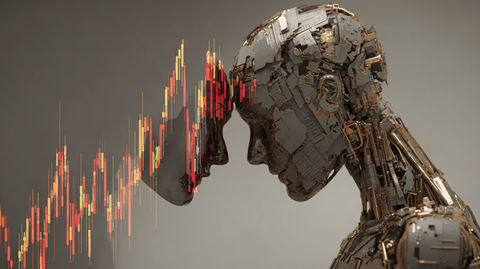
In my 30-year trading career, I’ve heard multiple times that a technology will ruin trading. First it was Day traders and Direct Access Trading, then it was Algorithms and High Frequency Trading. Each time the markets were terrified the technology would ruin their precious trading market. And every time, not only did it NOT ruin the market, it actually made it better!
Across nearly every profession today, a quiet anxiety is building. Artificial intelligence is no longer theoretical, it’s operational. Accountants are watching automation replace analysis. Lawyers are seeing software draft legal frameworks in seconds. Writers are competing with machines that can generate content at scale. The prevailing belief is that within a few short years, AI will displace countless roles because it can process more information, faster and without emotion.
So it’s only natural that traders, especially individual investors, begin asking an uncomfortable question:
If machines can analyze markets better than humans, will they eventually eliminate the need for us altogether?
After all, AI already plays a dominant role in financial markets. Institutions use algorithmic systems to deploy capital across equities, futures, forex, options, and cryptocurrencies. These systems monitor liquidity, volatility, correlations, and order flow with a level of speed and efficiency no human could ever match. To many observers, it feels like the rise of AI in trading signals the beginning of the end for the individual participant.
But that conclusion misunderstands the structure of markets, and more importantly, it underestimates the unique position of the retail trader.
Artificial intelligence in financial markets is not designed to eliminate participants. Its purpose is to identify meaningful movement of capital. Markets do not move because of intelligence alone; they move because of size. The entities capable of shifting supply and demand are not individuals trading modest accounts, but institutions deploying billions. Pension funds, hedge funds, asset managers, and sovereign wealth funds cannot simply enter or exit positions at will. Their orders are too large to execute instantly without dramatically impacting price.
As a result, they must accumulate positions gradually, distribute carefully, and often attempt to disguise their intent.
In doing so, they leave footprints.
These footprints appear in price structure, volume behavior, and liquidity patterns, the very signals that algorithmic systems and AI are designed to detect. Machines are not searching for the activity of smaller traders. They are focused on identifying institutional behavior because that is where meaningful market movement originates.
And this is where retail traders, particularly those equipped with the right education, gain an unexpected advantage.
A Trading Academy student managing a smaller account does not move the market. Their trades do not distort price discovery. They are not burdened by liquidity constraints or the need to hide their intentions. They can enter and exit positions quickly, without leaving a trace, and without the operational limitations faced by large institutions.
In other words, they can remain nimble.
While institutions must steer massive ships through narrow channels, retail traders have the flexibility of a Zodiac boat! They can react quickly to emerging opportunities and align themselves with the very institutional flows that AI is working to uncover.
Rather than replacing retail traders, AI is effectively shining a spotlight on the movements of large capital.
Institutions cannot become invisible. Their size forces them to operate over time, and that process inevitably creates recognizable patterns, areas of accumulation, distribution, and imbalance. As artificial intelligence becomes more sophisticated in identifying these patterns, it enhances transparency around where meaningful activity is occurring.
This does not remove opportunity; it clarifies it.
For Trading Academy students, this is where education becomes critical. The goal is not to compete with AI in computational power, but to understand what it is revealing. By learning how to recognize the structural footprints of institutional behavior, the very activity that algorithms are tracking, traders can position themselves alongside the forces that actually move markets.
In this sense, AI becomes less of a threat and more of an ally.
The continued advancement of technology may improve execution and efficiency, but it does not change the fundamental dynamics of supply and demand. Large capital must still enter and exit over time. Markets must still absorb that activity. And those processes will continue to create patterns that informed traders can identify and act upon.
Trading has never been about predicting the future with perfect accuracy. It has always been about positioning intelligently alongside size.
At Trading Academy, the focus has always been on equipping students with the skills to recognize these institutional footprints and understand the behavior driving market movement. As AI evolves, those skills become even more valuable, not less.
The future of trading is unlikely to be defined by humans competing against machines. Instead, it will be shaped by traders who understand how to interpret the signals that advanced systems help illuminate.
Artificial intelligence may change the landscape, but it does not eliminate opportunity for the informed retail trader.
In fact, for those who know how to read the market’s underlying structure, it may make the path forward clearer than ever before.
Because no matter how advanced technology becomes, the machines will always be searching for the elephants.
And with the right training, retail traders can move quietly alongside them, identifying opportunity, acting decisively, and maintaining an edge that AI was never designed to take away.