The End of the $25,000 Pattern Day Trading Barrier: Opportunity or Trap?
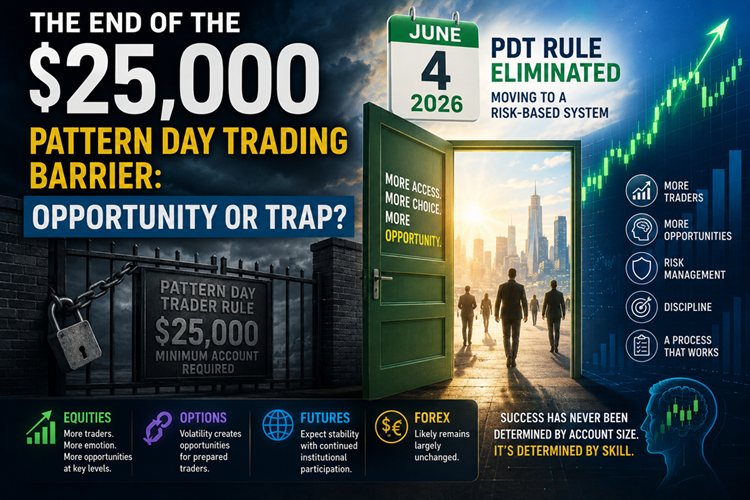
For years, one of the biggest frustrations for aspiring stock traders has been the Pattern Day Trader Rule.
You've probably heard it hundreds of times:
"I can't actively day trade equities because I don't have $25,000 in my account."
For many people, that rule became the obstacle standing between where they were and where they wanted to be.
Beginning June 4, 2026, regulators are planning on eliminating the Pattern Day Trader (PDT) Rule and moving toward a risk-based system. In simple terms, the equity market is moving away from restricting traders based on account size and moving toward evaluating actual trading risk.
At first glance, this sounds like great news.
And for many traders, it could be.
But before we start celebrating, it's important to understand what this change really means and what it doesn't mean.
More Access Doesn't Mean More Success
One thing I've learned after years of teaching traders is that most people believe their biggest problem is access.
"If I had a bigger account..."
"If I had more buying power..."
"If I wasn't restricted..."
Then everything would somehow get easier.
The reality is that trading success has never been determined by account size. It's determined by skill. Thus, the removal of the PDT Rule will likely create more traders, but it won't automatically create better traders.
In fact, whenever restrictive barriers come down, we usually see a large influx of newer traders entering the market. Many of them are enthusiastic. Many are motivated. Unfortunately, many are also overly emotional and underprepared, which often leads to more predictable behavior:
Overtrading
Chasing hot stocks
Fear of missing out (FOMO)
Emotional decision-making
Ignoring good risk management
Trading without a plan
Sound familiar?
The market has a way of teaching expensive lessons to people who haven't developed a process through skill-building.
The good news is that professional experienced traders often understand something important: When emotion increases, opportunity often increases as well.
Don't Expect Every Broker to Move at the Same Speed
While June 4th is the official date, don't assume every brokerage firm will implement the changes immediately. Some brokers will likely move quickly, where others will likely take their time.
Firms like Robinhood, Webull, Interactive Brokers, Lightspeed, and TradeZero are expected to be among the faster adopters.
Larger firms such as Schwab, Fidelity, and E*TRADE may take a more cautious approach as they work through compliance and operational changes.
In other words, just because the PDT rule is changing June 4th, does not necessarily mean your broker will also change overnight. More likely, this rollout will take place in stages over the next 18 months.
Where Could the Biggest Opportunities Occur in the Future?
Equities will see the biggest impact as more retail traders enter the day-trading arena; which could result in more emotion, more volatility, and more noise.
That doesn't necessarily make the market easier. But it can create excellent opportunities at quality supply and demand levels for traders who remain patient and disciplined.
The options market could also become more interesting. As stock speculation increases, options often follow; creating opportunities for traders who understand volatility and know how to structure trades around it.
As for futures? Don't expect major changes. Futures markets have always offered active traders flexibility, leverage, and efficiency. Institutional participation remains high, which tends to keep market behavior relatively clean.
Forex likely remains largely unchanged as well.
The Biggest Opportunities May Come Early
From June through August 2026, the Equity market could see a significant influx of newer retail traders entering the marketplace. Whenever that happens, inefficiencies tend to appear.
New traders make mistakes. They chase. They overreact. They panic, and they become more emotional and those behaviors can create opportunities for disciplined traders.
By late 2026 and into 2027, much of that adjustment period may work itself out as brokers, traders, and institutions settle into the new intraday trading environment.
How Should You Position Yourself?
Don't trade more. Trade better. The goal has always been consistency.
Continue focusing on the same rules/process that have always mattered to Professional skilled Traders:
Knowledge
Skills
Tools
Discipline
Risk Management
For many traders, futures and options may continue to provide some of the best opportunities because of their flexibility and capital efficiency. For equities, I believe selectivity becomes even more important.
Avoid the temptation to chase every headline, every social media post, and every stock that suddenly becomes popular. Instead, focus on quality setups, key supply and demand levels, and trades that fit your trading plan.
The Bigger Story Nobody Is Talking About
A lot of Equity traders are asking whether Equity leverage is going to increase because of the change in restriction?
The more likely outcome looks like:
PDT Rule disappears
2:1 overnight margin remains
4:1 intraday buying power remains
Risk-based margin models will become more common
Portfolio margin usage will expand
Futures-style leverage for stocks remains unlikely
So, the real story isn't necessarily more leverage. The real story is more access.
In the past, the $25,000 account requirement restricted millions of traders from accessing the markets. The new structure reduces that minimum to $2,000, opening the door to a flood of new, smaller traders.
That could have a much larger impact on market behavior than any leverage increase ever would.
Final Thoughts
Restrictions don't create successful traders. Education does. Discipline does. Experience does.
Although the removal of the PDT Rule may create new trading opportunities, it will also create new challenges.
For some traders, this change will become a catalyst for growth. For others, it may simply accelerate mistakes that were already waiting to happen. As always, your edge won't come from the rule change itself. Your edge will come from your ability to remain disciplined while everyone else becomes more emotional.
The markets are about to change.
The question is: Will your process be ready when they do?
Trade Well!